Product and UX folks ruthlessly research and analyze their users, to great effect. In fact a closing statement of mine in my team meetings is “go talk to your users”. While there is always room for improvement, this is a skill that we all know and employ well.
An artifact of that is often a user map. At its core, a user map is trying to answer questions around what is this person trying to do, what's getting in their way, and what do they actually need (which is often different from what they say they want). You're looking at goals, pain points, context, and behavior. And crucially, you're looking for the gap between what they say and what they do.
In contrast, the traditional stakeholder map, which we've explored before, is mostly about power and interest. Where does this person sit? How much do they care? How much can they affect your work? It's a useful diagnostic. But it's organizational, not human. It helps you categorize people. It doesn't help you understand them.
An interesting move is what happens when you apply the user research lens to a stakeholder. Instead of asking how much power this person has, you ask: what are they actually trying to accomplish this quarter? What are they afraid of? What are they protecting? What do they say they want versus what do they actually respond to? What context are they operating in that you can't see from your seat? Where is the friction in working with you (even if they'd never say it out loud)?
That's user research, but applied inward.
Designers, researchers, and product managers use this kind of curiosity every day. It's a skill. The shift is simply in recognizing that your stakeholders have pain points too. They have constraints you can't see. They have things they're trying to protect. Treating them accordingly - with the same rigor and genuine interest you'd bring to a user interview - tends to change the quality of the conversation. You can stop negotiating and start understanding.
STAND-UP EXERCISE
Choose one stakeholder your team interacts with regularly, perhaps someone whose priorities feel misaligned, or whose feedback is hard to predict, or who you find difficult to bring along.
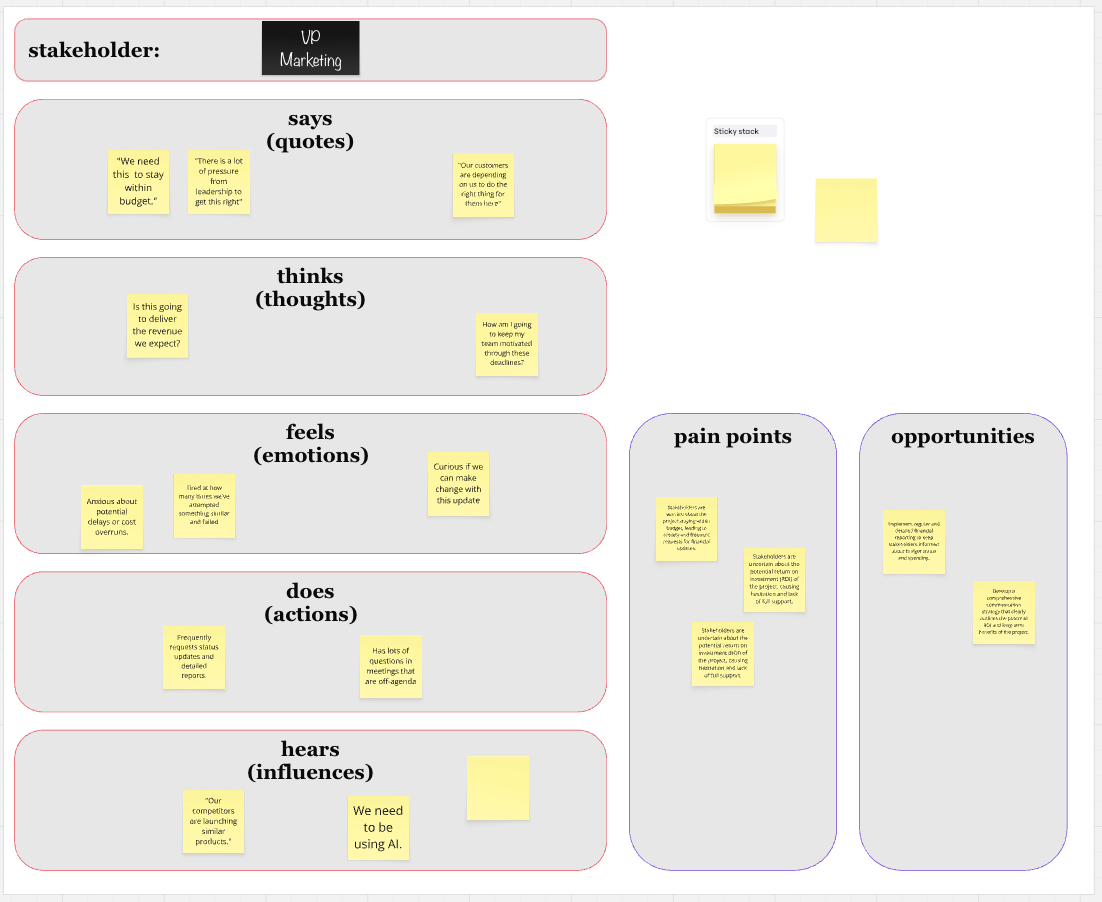
Using the same empathy map format you'd apply to a user map that stakeholder as a team. Work from what you already know: how they show up in meetings, what they push back on, what they consistently ask for, what seems to matter to them. Note where your knowledge is thin — those gaps are as useful as the answers.
I like to use a virtual whiteboard with the following sections:
Says: What are they saying about their expectations, concerns, and feedback? Get direct quotes from the stakeholder.
Thinks: What are they thinking but might not be vocalizing? Consider their worries, aspirations, and priorities.
Does: What do they do in relation to your product? Note the stakeholder's actions and behaviors.
Feels: How do they feel about the product or their involvement? Observe their tone and body language.
Hears: What might the stakeholder hear from others that influences their perspective? Feedback from colleagues, market trends, or industry news…
Once you have this, you can begin brainstorming pain points and opportunities. Try to pinpoint specific areas where the stakeholder faces challenges or frustrations. And then highlight areas where improvements could be made to better meet stakeholder needs and expectations, and improve the relationship.
When you're done, sit with the map for a moment. Does anything surprise you? Where are you making assumptions you haven't tested? Is there a conversation you could have, or a way you could frame your next interaction, that accounts for what you now see? Which of the opportunities are you going to take advantage of?
The goal isn't to psychoanalyze your colleagues. It's to bring the same quality of attention to the people inside your organization that you already bring to the people outside it.