Job/Career Priorities

by Kristen DeLap


Job news is everywhere right now. The jobs report was released last week, showing lowest unemployment rate in decades, even as tech companies continue to lay off workers. The Great Resignation that began in 2021 continues, but recent reports have come out citing those who left their jobs feel regret about their decisions. Companies continue to update and mandate return to office policies as the pandemic wanes and a recession looms. All of this can lead to a very charged workplace.

Team morale is an outsized contributor to product team efficiency and outputs. How individuals feel about their employer, their position, their work life contributes greatly to their success on a product team. Even though these larger conversations might not feel like they directly impact a backlog or a sprint, they certainly affect the individuals managing that work.

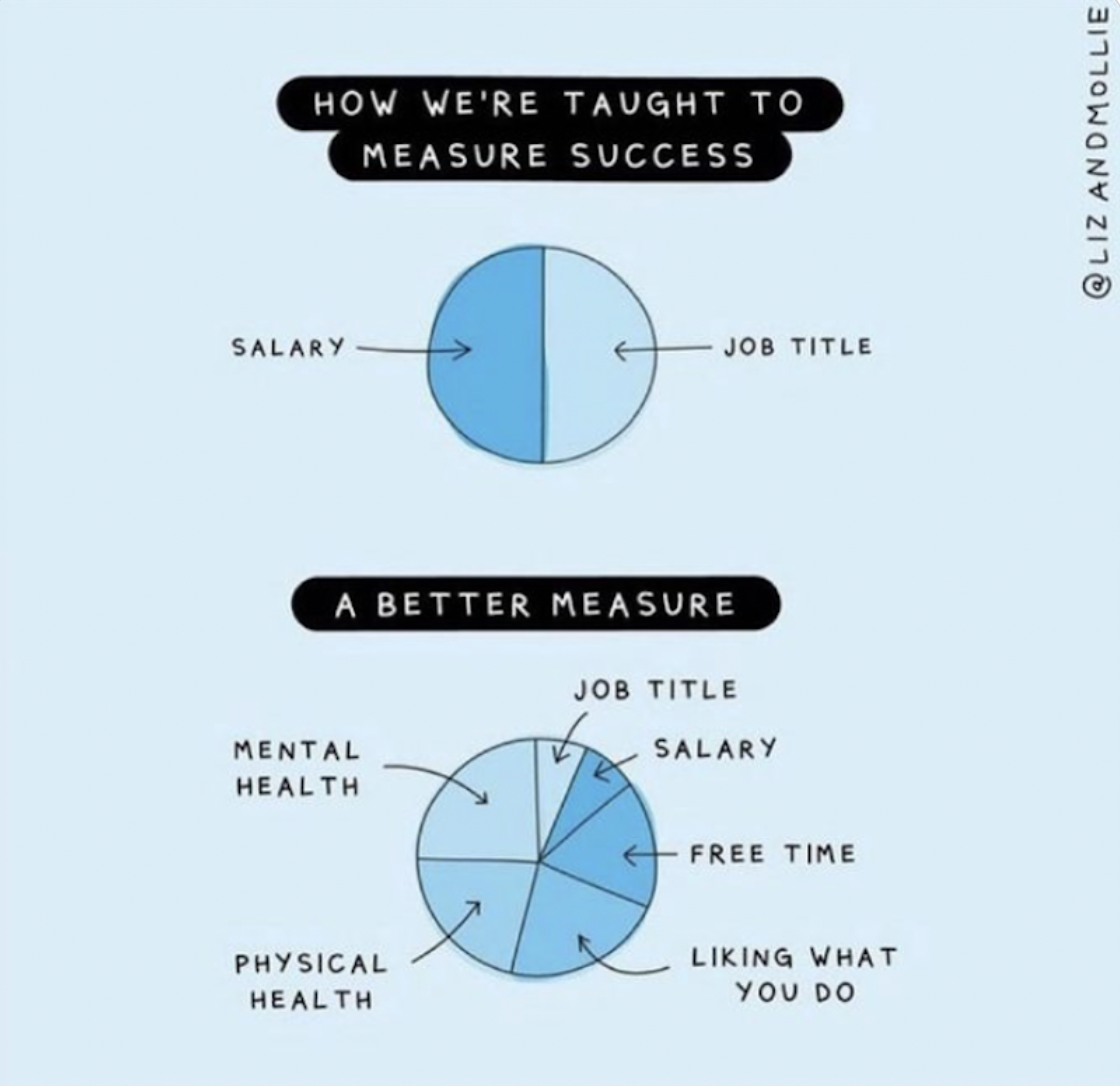
This graphic by @lizandmollie of how we do and could measure success on the job is telling.

All workplaces are different. And what you need at different times in your life and your career might be met or not by your current workplace. Employees should understand what their true needs are and if the workplace can meet those needs or not, either now or in the future. Sometimes reframing the discussion in these terms can help an employee who was feeling anxious understand their stability; conversely it can also help an employee on the fence decide what is right for them.

This is not to take any responsibility away from the company. As product leaders, we should continue to positively affect the culture of a company in all the ways that we are able, advocating for our team members, their advancement, and their work life quality. Companies should of course be changing and adapting to an evolving workforce as well.

If possible, let’s continue to help contextualize the bigger picture to our product teams, and hopefully create a more stable engaged team by doing so.


STAND-UP EXERCISE

Begin by showing your team the above graphic from @lizandmollie. Explain the concept of needs and priorities with a job changing over time or based on life circumstance.

Ask folks to on their own (not publicly) assign a percentage to their career priorities based on the list - Pay, Benefits, Title, Balance, Flexibility, Impact, Passion. Feel free to adjust categories, especially as it makes more sense culturally/regionally - countries with more standardized federal/state benefits might not have that as category, for example. After giving folks time to tally their responses, ask them to move a dot into the bubble that aligns with their number one priority right now. If you feel comfortable generalizing, you can talk about how this might compare to the company’s ability to respond to these needs/priorities.

Encourage folks to talk to their manager about their job priorities if they haven’t already. This is a good exercise to encourage folks to do every 4-6 months, to see if anything has changed for them.


Cumulative Actions

by Kristen DeLap


Cumulative actions are compounding effects - the sum of the whole effect is worth more than the individual effects of the parts. The phrase actually comes from medicine, where it can be lethal. Repeated consumption of a drug, even small amounts, can accumulate enough in your body to become toxic. However, we can think of it more positively in terms of actions throughout our day that can collect into a habit. About 43% of our actions or behaviors are habitual - it is how we maintain the cognitive space to function as humans.

Most daily actions evaporate. Some accumulate. To pinpoint the ones that accumulate, and identify the accumulation as positive or negative can be a very enlightening exercise. James Clear writes in his very popular Atomic Habits that, “Every action you take is a vote for the type of person you wish to become. No single instance will transform your beliefs, but as the votes build up, so does the evidence of your new identity."

This accumulation of “votes” or actions can happen in our personal lives or our professional lives. The exercise below can help make them more intentional.


STAND-UP EXERCISE

In a white-boarding tool, ask the team to identify daily actions that are serving them, ones that they could begin to accumulate. And then in a separate column ask which actions are not serving them, and perhaps are negatively accumulating. Leaving the responses open to personal and professional scenarios opens up talk about scheduling a day, or work/life balance, or some challenges of working remotely. This exercise works especially well in a format where team members can “up vote” or +1 other’s responses.

Whiteboard with sticky note examples of cumulative actions

Negotiation Tactics

by Kristen DeLap


One of a product managers most used, but perhaps most underrated, skills is negotiation. Almost every conversation a product manager has can feel like a request that needs to be weighed and agreed upon in some fashion. While a product manager can (and should) say “no”, the way in which they get to the no, or verbalize the no, is all about negotiation. It is a key pillar of communication, and one that can affect speed, outcomes, and team morale.

Specific negotiations with a pessimistic developer, or an over-promising salesperson, or an impassioned stakeholder will be different. But there are core strategies that remain the same.

When we think about negotiations, we often think of them as positional - where each party stands in opposition and applies pressure in attempt to get the other to yield. This is most often seen in bargaining transactions, or when someone is talking about “holding a hard line.” However, the better approach is often principled negotiations, where all parties come together as a team to find the best outcome and maintain the relationship. The Department of Product wrote up an informative article that summarizes the findings of the Harvard Negotiation Project on principled negotiations well.

According to the study, there are 4 facets which make up principled negotiation:

  1. People - Try to separate the people from the problem, by focusing on the real issue, not who brought it up. Then be sure to bring in empathy for the multiple perspectives involved, participation from those people, and resist the temptation to get emotional.

  2. Interests - Understand the shared interests, which are common to all parties, and the divergent interests, where they disagree. Also keep in mind many interests can be traced back to security, wellbeing, sense of belonging, recognition, or control, and so try to address these root causes first.

  3. Options - Generating options for an outcome should be separate from deciding, and no option is a bad one when you are just at the brainstorming phase. Then compare and contrast within your list.

  4. Criteria - Attempt to use objective criteria wherever possible in your negotiation to move away from emotional influences. Search for criteria like fair market comparisons, professional standards, scientific judgement or raw data to analyze options.

A product manager even tackling one or two of these strategies in their daily interactions can rapidly move them toward more effective communication. Not every negotiation feels like intense conflict, it can simply be a question of priorities or slightly different goals. Negotiation isn’t inherently a good or bad thing, but getting to the best answer makes a difference for speed, morale, and outcomes. And, importantly, the best answer isn’t winning - it is a result that is good for all involved, takes the appropriate amount of time to get to, and preserves or even strengthens relationships.


STAND-UP EXERCISE

Give a prompt to product managers to ask them about a negotiation conversation they had this week / sprint / cycle. Examples might include - an executive wanted a new feature added to an MVP; do we prioritize working through this technical debt or getting started on this new initiative; the designer wants more time to iterate and the engineers just want to get going; our lead candidate just got another offer for $10K over our budget; do I really need to attend this meeting or can I send another team member…

What went right? What went wrong? Using investigation of the four facets of principled negotiation, where could they have dug in deeper? Be sure to share yourself, as negotiation is not a once-and-done skill, but a learning path for all of us.

A following stand-up could come back to this topic and ask if anyone was able to use these techniques to find a desired or beneficial outcome.

BONUS:
The Prisoner’s Dilemma is a famous game theory problem that shows that single event negotiation is very different from multiple event negotiation. On any given product team, you’ll need to negotiate often, so it is best to stay focused on the long term relationship. Have your team play though this interactive game “The Evolution of Trust” to learn and enact the theory.


New Year Maxim

by Kristen DeLap


Calendar New Year is fraught with folks setting goals and resolutions. As we know, so many times this type of thing fails out of the gate - research says the failure rate for New Year’s resolutions is about 80%. And a dichotomy is created in the workplace, as often times a fiscal calendar or fiscal quarter professional goal setting doesn’t correspond to the standard Gregorian calendar.

While my organization’s fiscal half falls this time of year, it isn’t a major time of resetting goals. However, these types of calendar milestones are places where people reassess and perhaps are motivated to shift behaviors. Because of that, I think it is important to address as a group. (Note, another good time for this is the start of a school year - while not everyone is a student, or has students, this type of cultural milestone exists in many places.)

Instead of setting resolutions, I ask my team to think about how they are feeling heading into the new calendar year. It’s a bit of taking stock of their energy level and their mentality - a general check-in. And then, steering clear of specific goals or things they want to change, I ask for a word or maxim as they look ahead. The time period of a coherent 12 months can also be hard conceptually, so a general forward outlook may be preferable to a specific time frame. The idea of choosing a “word of the year” has almost a cult following at this point, but even a less rigorous process can still yield thoughtful responses. Additionally, it allows us to see our teams and colleagues wishes and hopes (or struggles and roadblocks) a bit more clearly.


STAND-UP EXERCISE

Once the dust of the holidays settle, prepare a whiteboarding session with a “emotion wheel” or something similar. Ask folks to identify their current state. (I ask that they name two adjectives, as you can have someone who is excited AND anxious or enthusiastic AND confused - it is good to know both.) I leave this part anonymous, so that folks can be honest, but ask them to share their responses if they wish.

Then ask them to add stickies for a maxim / word / wish as they look forward. Ideally sharing with the group provides insight and camaraderie.