Product Delight by Dr. Nesrine Changuel argues that in a market where almost everything works, working is no longer the differentiator.
Once a product reliably does its job, what sets it apart is how it makes people feel. Changuel, who has built products at Google, Spotify, and Microsoft, set out in her book to "demystify the concept of delight and raise awareness of its power.” What we learn is that delight is something you can design on purpose rather than sprinkle on at the end.

She splits delight into three understandable buckets.
1. Low delight solves a functional need and nothing more.
2. Surface delight speaks to an emotional need but not the core job, the playful flourish that makes you smile and then fades.
3. Deep delight does both at once, solving the problem and earning the attachment.
Her Delight Grid maps solutions against functional needs on one axis and emotional needs on the other, so a team can see at a glance how much of its roadmap is low, surface, or deep.
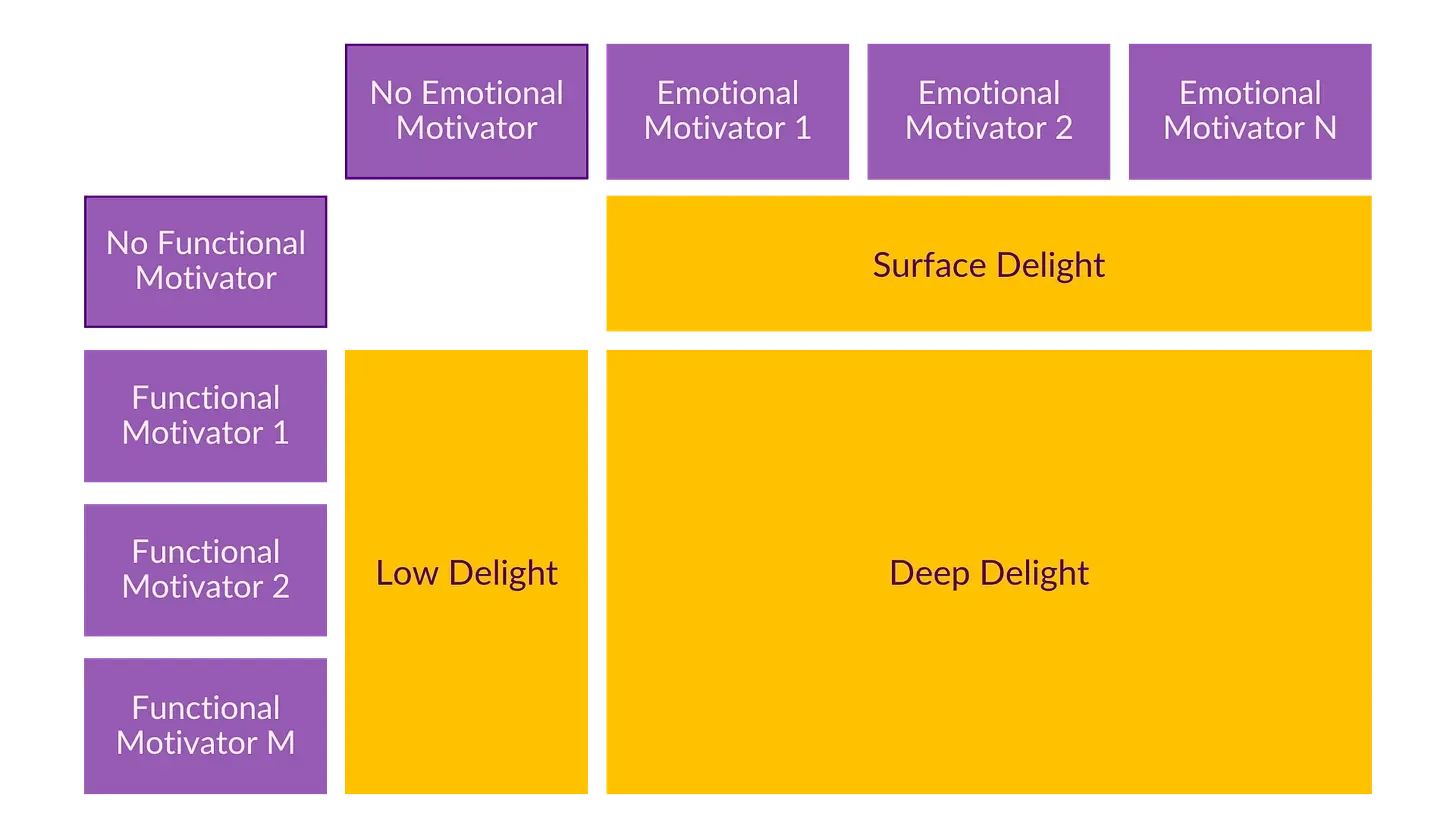
Source: Nesrine Changuel, "The Delight Grid."
What I keep coming back to is her 50/40/10 rule: roughly half your roadmap on core utility, 40% on deep delight, and 10% on surface delight. It is genuinely hard to balance delight against function, and a simple ratio gives a team shared language for that tradeoff instead of relitigating it feature by feature.
She is just as practical about proving it matters. Rather than trying to put a number on an emotion, she tracks its effects, like moving Skype from a vague satisfaction score to a single operational metric, the Poor Call Rate, that the team could actually move. Each product will have a different way to measure delight, but she gives some ideas on how to get started. The through-line is her case that "when delight is treated as a strategic lens rather than a finishing touch, entire organizations can rally around creating products that are not just functional but unforgettable."
Some questions worth sitting with as a product team:
If we sorted our current roadmap into low, surface, and deep delight, where would it land? Anywhere close to 50/40/10? (Read her book or website to learn about motivators and how to more accurately create your grid.)
Where could something we have already shipped be lifted from low delight into deep delight without much added scope?
What is our version of the Poor Call Rate, the one metric that would tell us whether delight is present or missing?
If functionality is table stakes in our market, what emotional need is our product really meeting, and do we agree on what it is?
I saw Dr. Changuel speak earlier this year. She was a dynamic speaker, introduced and then in a Q&A with Matt LeMay, whose own book, Impact First Product Teams, I wrote about here. Seeing the two of them together was a nice bit of synergy. What stuck with me was how concrete she was, pulling delight out of ordinary daily interactions and out of her own work as a PM, walking through how she reasoned about these tradeoffs with her team and made the case for them. It is one thing to read the framework and another to watch someone use it to advocate for the work. Definitely a book to add to your professional product library.